1858 circa – Émile-Jean Lépissier with his children Laurent and Juliette

Before departing for China (1826-1866)
Émile-Jean Lépissier (李璧諧 – Lǐ bì-xié), born on 6 December 1826 in Paris at 188 rue Saint-Antoine, in the IVth arrondissement, in the heart of the Marais, was the son of Jean-Nicolas Lépissier, a grocer in Paris.
After excellent studies at the Lycée Charlemagne in Paris, Émile-Jean first became a lecturer in mathematics in this Lycée
From around 1850, Émile-Jean then worked as an actuary in the "Compagnie Royale d'Assurance sur la Vie" (Royal Life Insurance Company).
He married Marie-Augustine (known as Maria) Boissard with whom he had four children, only two of whom survived to adulthood : Émile-Laurent born in February 1850 and Juliette-Lise born in June 1855.
In January 1854, after Urbain Le Verrier was appointed head of the Paris Observatory following the death of Arago in 1853, Émile-Jean Lépissier applied and promptly joined him at the Observatory in September 1854.
Émile-Jean was quickly promoted to Deputy Astronomer in October 1857.
Le Verrier’s difficult character and at times brutal management style led many colleagues to quit the Observatory.
As a result, Emmanuel Liais, a friend and colleague of Émile-Jean, left for Brazil. This gave the latter ideas.
Having failed in his attempts to be named as an astronomer for the French cultural and scientific expedition to Mexico which was to follow the 1862 military expedition, Émile-Jean accepted a proposal from the Ministry of Foreign Affairs, through the Ministry of Public Instruction to leave for China as an astronomer.
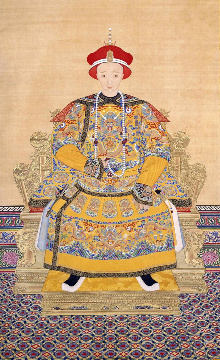
Portrait officiel de l'empereur Xian Feng
Life in China (1867-1871)
In October 1866, the Ministry of Public Instruction instructed Émile-Jean Lépissier (李璧諧 – Lǐ bì-xié) to join a “scientific mission to China whose purpose is to deliver astronomical and geodetic observations” In actual fact, Émile-Jean left to teach the French language
Émile-Jean was indeed named as the first French teacher at the Tóng Wén Guǎn (同文館) − which would become the University of Běijīng – 北京) – the first Chinese learning institution for Western languages and techniques, created in 1862 for the Chinese literate.
The Tóng Wén Guǎn depended on Zǒnglǐ Yámén (总理衙门), the predecessor of the Chinese Ministry of Foreign Affairs, but its costs were met by the Chinese Imperial Maritime Customs (大清皇家海關總稅務司 – Dà Qīng huángjiā hǎiguān), led by Briton Robert Hart and which therefore in practice effectively controlled the Tóng Wén Guǎn.
Émile-Jean left alone for China in August 1866. His wife Maria and their children, Laurent et Juliette, joined him the following year. The family lived on “Dry Fish” street" (甘雨胡同) in Běijīng. China was then ruled by Xiánfēng (咸丰), le 8th Emperor of the Manchurian Qīng dynasty (清).
As he knew Robert Hart well, Émile-Jean made his son Laurent join the Chinese Imperial Maritime Customs in June 1869.
It was however at that time very difficult for foreigners to teach Chinese who did not always agree to receive teachings from “Western barbarians”. This made for a difficult experience for several teachers at the Tóng Wén Guǎn.
Having disagreed with the reorganisation of the Tóng Wén Guǎn on the orders of W.A.P. Martin, an American, Émile-Jean was removed from office in February 1870. He was replaced by Charles Vapereau who stayed at the Tóng Wén Guǎn for many years.
Bitter, Émile-Jean then left with his wife and daughter for Shànghǎi (上海) where he hoped to become successful. In January 1871, he created there a newspaper called 'Le Progrès' (The Progress), of which he was the manager and editor in chief.
However, he faced direct competition from another French newspaper in Shànghǎi, 'Le Nouvelliste de Shanghai', founded by a stateless (but French-born) adventurer, Auguste Beer, a few months before 'Le Progrès'.
A great animosity developed between the two men and both newspapers ended up folding after a few months.
Towards the end of 1871, Émile-Jean Lépissier decided to return to his original job and signed a contract to become a professor of astronomy in Japan.
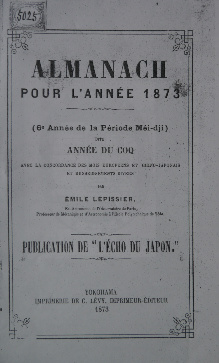
Almanach pour l'année 1873 publié par Émile Lépissier à Yokohama
(courtoisie du Prof. Tsuko Nakamura)
Life in Japan (1872-1874)
Émile-Jean arrived in Japon in January 1872 with his wife Maria and his daughter Juliette. Japan was then still under the calendar of the Meiji era.
Émile-Jean was officially employed by the Japanese government to teach algebra, geometry and mechanics at the Kaisei-gakko school (東京開成学校) which would become the University of Tokyo. The Japanese 'Kaisei-gakko school' was the equivalent of the Chinese 'Tongwen Guan'.
From February 1873, he taught astronomy at the Kaisei-gakko school.
He was one of the five first Westerners to climb the Fuji Yama, in July 1873, in order to measure its hight.
In January 1874, he signed his contract to teach astronomy at the Kaisei-gakko school (Tokyo University).
However, in June 1874, a very ill Émile-Jean quit and returned to France with his wife and daughter.
Passionate of languages and philology, Émile-Jean had perfect command of Latin and Greek and already spoke German, Basque and Briton before his arrival in China. He would then learn to speak English and Mandarin Chinese very well (he even acted as a Chinese interpreter aboard the gunboat “la Flamme” [the Flame] following the Tiānjīn massacres of 1870). He also managed with Japanese fairly well to teach his lessons.
He died in Paris on 21 October 1874, at the age of 48.
§§§§§§§§§§§§§§§§§§§§§
You can find more details about the life of Émile-Jean Lépissier in the following link: 'Livre sur Émile-Jean Lépissier (1826-1874)' – 474 pages and 217 illustrations (Only available to members of the Association Émile-Jean Lépissier)
§§§§§§§§§§§§§§§§§§§§§
During the 'VIIIth International Conference on Oriental Astrology' which took place in March 2014 in Hefei in China, the Professor Tsuko Nakamura (Teikyo-Heisei University, Japan) and Mrs Suzanne Débarbat (Observatory of Paris) presented a joint study entitled'Emile Lépissier (1826-1874), French Astronomer of misfortune who taught first in China and in Japan' dont la conclusion est la suivante : "We must remember and appreciate Emile Lépissier's role, played as one of the founders of the early astronomical education system in China and Japan".
You will find below the written presentation, in japanese, made by Prof. Tsuko Nakamura.
The "Journal of Astronomical Histrory and Heritage" of the University of Science and Technology has published in English in its Vol. 26 N°4 of December 2023, the translation of the paper (in Japanese) by Professor Tsuko Nakamura (Teikyo-Heisei University, Japan) and Madame Suzanne Débarbat (Observatoire de Paris) of March 2014 to which historical contexts have been added.
§§§§§§§§§§§§§§§§§§§§§
Redirections :
- Go to 'Legal Notices & GDPR' (Publicly available)
- Go to 'Repères chronologiques, historiques et familiaux' (Publicly available)
- Go to book 'La famille Li' (Publicly available)
- Go to 'Laurent Lépissier' (Publicly available)
- Go to 'Charles Lépissier' (Publicly available)
-Go to 'Map of China' (Publicly available)
© Tous droits réservés