1937 – Charles Lépissier – General Consul of the French concession of Tiānjīn
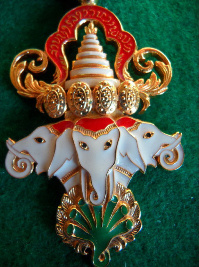
The Ordre of the Millions Elephants and the White Parasol (Laos)
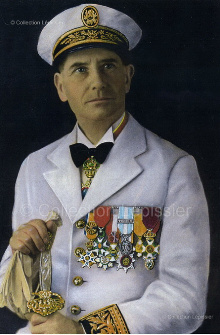
Charles Lépissier (李畢廲 – Lǐ bì-lí) was born on 23 May 1882 in Canton (Guǎngzhōu – 广州).
He was the eldest son of Émile-Laurent (李坒丽 – Lǐ bì-lí) and Blanche Lépissier.
At the age of six, he was sent to France for his schooling and placed in the care of his maternal grandmother. Following his studies in law and Chinese at the School of Oriental Languages, he returned to China at the beginning of 1907 as a young diplomat.
Charles was first posted to Shànghǎi (上海) from the beginning of 1907 to December 1908. He then worked in Peking (Běijīng – 北京) for two months until February 1909, before going to Guǎngzhōu for 15 months until August 1910. From September 1910 to January 1911, he was in Yúnnánfu (today called Kūnmíng) in the Yúnnán, before spending a few months in Shànghǎi and returning to France for his first leave of nine months until January 1912.
On his return to China in February 1912, Charles went back to Shànghǎi where he stayed until June 1913, with a two-month interlude in Méngzì (蒙自) in the Yúnnán (云南) in the summer of 1912. From June 1913 to March 1914, Charles Lépissier worked in the consulate in Lóngzhōu (龙州) in the Guǎngxī (广西), before staying in Yúnnánfu (Kūnmíng – 昆明市) in the Yúnnán from April 1914 to December 1918. During this stay, Charles was sent for a military intelligence mission for five months in Sīmáo (思茅), in the Yúnnán. He ended his second stay in China with a three-month stint in Běijīng (January-April 1919) where, amongst other things, he replaced a professor of French at the University of Běijīng, and a two-month stay in the Tonkin.
From May 1919 to May 1920, he was on leave in France, during which time he married Madeleine Gerber on 14 February 1920.
On his return to China with his wife, Charles was named Consul in Harbin (Hā'ĕrbīn – 哈尔滨) in Manchuria, where he remained from June 1920 to October 1924. His two eldest children were born there: Henri on 6 April 1921 and Geneviève on 29 January 1923.
From October 1924 to October 1925, the family was on leave in France, where their third child, Jacqueline, was born on 9 August 1925.
On his return to China, Charles was named Consul in Yúnnánfu, replacing Albert Bodard, where he stayed from October 1925 to August 1929. His fourth and last child, Jean-Marie, was born in Yúnnánfu on 3 December 1927.
Following a leave in France from April 1930 to April 1931, Charles took charge of the Consulate of the French Concession of Tianjin (Tiānjīn – 天津). A year of leave from May to December 1935 interrupted this stay.
Charles was named Consul-General on 28 December 1937 and became the most senior member of the consular body of Tiānjīn.
Charles spoke English very well. He spoke excellent Mandarin and Shanghai Chinese and got by in Cantonese. As for Madeleine, she was bilingual in English, spoke Russian and a little Mandarin.
Charles and Madeleine returned to France on leave in March 1939. Because of the war, Charles never went abroad again.
Charles was promoted to Minister Plenipotentiary with retrospective effect from 1 January 1942.
Charles then went into politics for a while.
Suffering from hemiplegia from the spring of 1962, Charles Lépissier remained paralysed until his death on 28 February 1975 in his house in Versailles.
Charles received a number of honours. He became Commander of the French Legion of Honour (“Légion d’honneur).
In 1916, he also received the “High Laos/Tonkin” colonial medal with a clasp for his military intelligence mission in 1915/1916. He also became Officer of the Italian Order of the Crown (1925), Knight of the Order of Leopold (Belgium) in 1928, Great Officer of the Order of the Nichan-Iftikar (Tunisia) in 1935, Officer of the Order of the Phoenix (Greece) in 1925, Officer of the Order of Orange-Nassau (Netherlands) in 1938. He received the White Cordon with Red and Blue Borders of the Order of Brilliant Jade (China) in 1938. He became Commander of the Order of the Million Elephants and the White Parasol of the Kingdom of Luang-Prabang (Laos). He was Grand Officer of the Order of the Royal Star of Grand Comoros (1952).
Charles also received a large number of other Chinese honours.
Charles Lépissier’s life is further detailed in four parts:
- Charles Lépissier : The first posts (1907-1920) (Publicly available)
- Charles Lépissier in Hā'ĕrbīn, Mandchouria (1920-1924) (Publicly available)
- Charles Lépissier in Yúnnánfu in the Yunnan (1925-1930) (Publicly available)
- Charles Lépissier in Tiānjīn (1931-1939) (Publicly available)
© Tous droits réservés
Redirections :
- Go to 'Legal Notices & GDPR' (Publicly available)
- Go to 'Historical and family chronological landmarks' (Publicly available)
- Go to book 'La famille Li' (Publicly available)
- Go to 'Émile-Jean Lépissier' (Publicly available)
- Go to 'Laurent Lépissier' (Publicly available)
-Go to 'Map of China' (Publicly available)